MIG vs. TIG Welding: Which Is Right for Your Project?
Big West knows that selecting the best welding process for an industrial project is crucial. If you work in the oil & Gas, construction or manufacturing industries, your welds will have an impact on your safety, durability and profitability. As a provider of welding and fabrication services in Alberta, we are often asked what the differences are between MIG welding and TIG welding. Also, which technique would work best with specific applications?
MIG and TIG Welding
Two of the most common arc-welding processes are MIG (Metal Inert Gas), also called Gas Metal Arc Welding, and TIG welding (Tungsten Inert Gas), also called Gas Tungsten Arc Welding. The two methods use an electric arc for joining metals. However, they are very different in their technique, equipment and applications.
MIG welding uses a wire electrode consumable that is fed continuously through the welding gun. Wire is used as an electrode and filler. It melts to create the weld joint. An inert shielding gas, usually argon or a mix of argon and carbon dioxide, keeps the weld pool clean from contamination by atmospheric agents. MIG is known for its ease of use and the ability to create strong and consistent welds.
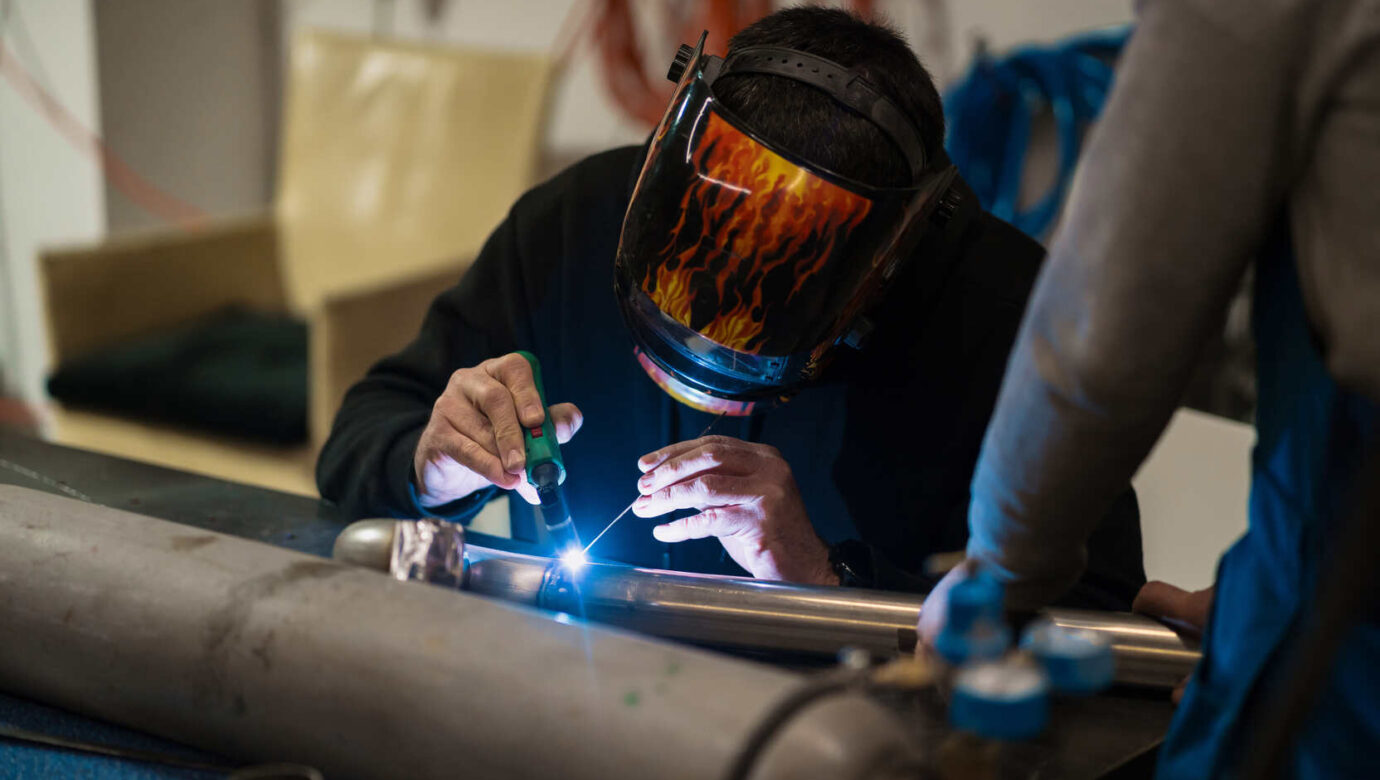
The TIG welder, however, generates the arc using a non-consumable, tungsten electrode. The welder will manually insert a filler rod into the pool of weld. TIG welding also relies on an inert shielding gas, usually pure argon. This helps to avoid contamination and oxidation. The process is renowned for its accuracy, control and the ability to create high-quality welds that are aesthetically pleasing, particularly on non-ferrous materials.
Technical Comparison
It is important to consider the advantages and disadvantages of each welding process when selecting one for welding and fabrication services in Alberta. MIG welding has a high rate of deposition and is very productive. It is ideal for projects that require speed, such as large-scale steel fabrications and structural steelwork. MIG welding can also be more tolerant of minor contaminants on the surface, such as mill scale or rust.
By contrast, TIG offers better control of the heat input and the weld beads, which results in cleaner and more precise joints. TIG is the best choice when appearance, minimum spatter and precise tolerances are needed. TIG is particularly effective when joining thin-gauge materials, exotic metals and components that require a high level of metallurgical strength. TIG welding is slower and more difficult to do, meaning the costs are higher.
Application in Alberta’s Industrial Sectors
MIG welding has become a popular method in Alberta’s construction sector for fabricating, erecting, and installing structural steel beams and columns. Its adaptability and speed make it ideal for large-scale projects with short deadlines. The MIG process manufactures heavy machinery and equipment that requires a combination of fast production and strong welds.
While TIG is less popular in structural high-volume work, it’s essential for specific applications. TIG welding is used in the oil and gas industry for components such as pressure vessels, pipe, or parts that must withstand high temperatures, corrosive conditions, etc. To meet industry standards and codes, TIG welding can create defect-free, quality welds. The TIG process is used to fabricate stainless steel tanks and piping for factories, as well as custom-made assemblies.
Our team at Big West is skilled in MIG and TIG, which allows us to provide tailored solutions for industrial clients. We offer welding and fabrication services in Alberta to suit the needs of every industry, be it for rapid production, high-specification, or intricate welds.
Material Considerations
MIG or TIG depends on many factors, including the thickness and type of material to be joined. MIG welding is best for thicker sections made of carbon steel. It can also join mild steels, stainless steels, and aluminum. MIG welding is flexible and can be customized to suit different alloys or joint configurations. It also accommodates a wide range of shielding gases and wire types.
TIG is the ideal method for welding thin-gauge materials or metals prone to burn through and distortion. This is the method of choice for welds made on aluminum, magnesium, copper, titanium, and autogenous welds. TIG is versatile enough to be used for dissimilar metals and in applications that require minimal post-weld finishing or cleaning.
Quality and Inspection
Any welding and fabrication service provider in Alberta should place quality assurance at the top of their list. When performed properly, MIG welding produces welds that are strong and ductile with excellent mechanical properties. However, MIG can be more susceptible to problems such as lack of fusion, porosity and incomplete penetration. Automation or semi-automation of MIG systems may help to maintain consistency. However, operator skills and attention are still key.
TIG welding is used for joints that need a high degree of precision, like radiographic and ultrasonic tests. It’s a slow, deliberate process that allows meticulous control over the weld pool, leading to minimal defects and better metallurgical characteristics. TIG welds have a lower likelihood of containing inclusions and porosity. This makes them ideal for applications requiring high pressure, purity, or safety.
Our team at Big West adheres to strict quality control protocols for MIG and TIG welds. We train our certified welders regularly to meet the latest standards and industry practices. Our welding and fabrication services in Alberta are always up to date with CWB standards.
Cost and Efficiency
When selecting a process, cost is always an important factor. MIG is a more efficient welding process for large-volume production because of its lower cost and faster speed. Automation can further lower costs and increase throughput. This makes MIG welding attractive to manufacturers and contractors who work on large projects.
TIG welding is slower and requires more work, despite its superior quality. TIG welders’ higher levels of skill can contribute to labour cost increases. TIG is a good investment for those projects that require a high level of weld appearance or quality.
Big West evaluates project needs and recommends the best, most cost-effective solution. We have years of experience in Alberta’s various industrial sectors, which allows us to deliver value-driven services that balance quality and productivity.
Safety Considerations
MIG and TIG pose potential risks, such as exposure to UV radiation, high temperatures, fumes and other hazards. To ensure the safety of workers, it is vital to have proper training, use personal protective equipment and provide ventilation. We maintain a safety culture and adhere to all occupational health and safety regulations.
Making the Right Choice for Your Project
The decision to choose between MIG and TIG isn’t a simple one. Material type, thickness and joint configuration are all factors that affect the optimal welding process. Production volume, budget, weld requirements, etc., also play a role. Big West takes a consultative approach to project specification, assessing our client’s needs and recommending the best welding technique.
We have the expertise to handle a wide range of projects. Our technical expertise, skilled welders and commitment to client satisfaction back up our welding and fabrication services in Alberta.
Contact Big West for help with welding or fabrication services for your project. We are ready to offer the best welding and fabrication services in Alberta. This will ensure that your project is finished safely, efficiently and with the highest quality standards. Contact us today to learn more about how we can help you.