Aluminum Welding: TIG vs MIG, Choose the Right One
At Big West Machine & Welding, we often hear this question: Should I choose TIG or MIG for my aluminum job? Ultimately, the decision depends on the item being constructed, what it is used for, its design requirements, production speed requirements and your budget. As a full-service aluminum welding shop in Alberta, we offer both TIG and MIG welding and provide advice on when each method excels and when its limitations should be noted. Our goal is to create clean, quality and reliable welds for our clients in Drayton Valley, Alberta.
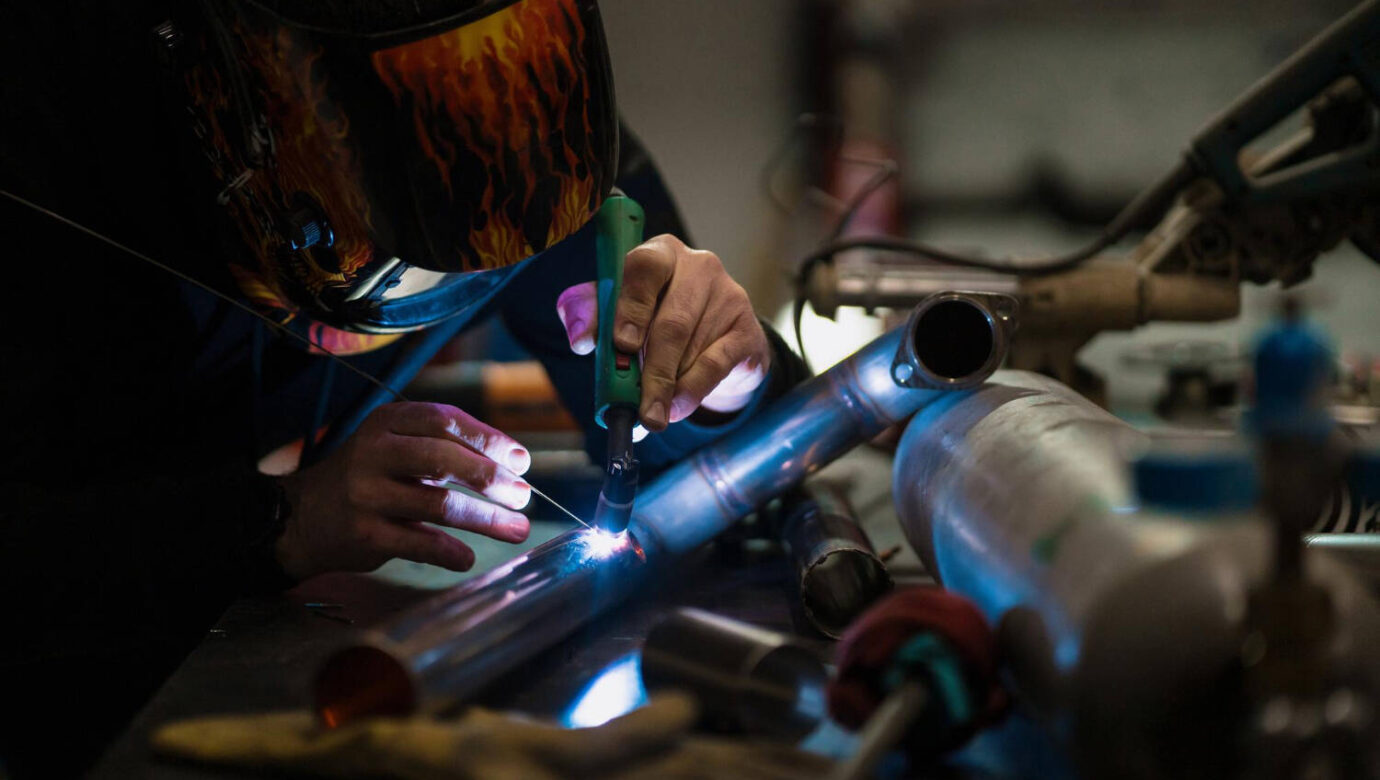
TIG welding (Gas Tungsten Arc Welding) is typically associated with fine aluminum work. TIG can control its heat with either foot pedal or fingertip controls while adding filler metal by hand. Arcs are extremely stable tools, when properly set up they produce very clean beads with little spatter or waste produced during processing. TIG welding’s control and cleanliness make it ideal for thin-gauge aluminum welds on visible components as well as critical joints where penetration, fusion line cleanliness, and distortion control are of concern. Visit our aluminum welding shop in Alberta to take a look at our TIG welding.
MIG welding (Gas Metal Arc Welding) takes an alternative approach. Instead of independently controlling heat and adding filler manually, a wire feed gun provides both filler and the arc all at the same time. On aluminum, wires are typically soft, such as 16-gauge wire; feeding it through a push-pull system can prevent bird nesting. This approach results in faster welds. MIG metal deposition can occur much more rapidly than TIG welding, making MIG an excellent option for work that demands high productivity, thicker sections or long seams with limited seam spacing. MIG welding provides fast yet strong solutions when building trailer frames, structural skids and large tanks with long fillet welds.
TIG welding offers instantaneous heat modulation, which prevents burn-through on thin materials while minimizing distortion in panels. By contrast, MIG requires continuous manual adjustments of heat intensity, which may result in greater distortion during welding. As the arc is narrow and slow-burning, its heat-affected zone remains narrow and manageable when joint design and fit-up are properly done. MIG welding typically generates greater levels of total heat due to higher deposition rates and travel speeds. We typically address this with fixturing techniques like skip welding patterns and preplanned welding sequences, but when working on components that must remain perfectly true, like thin flat panels that require perfect dimensions, TIG welding will usually provide superior dimension control.
Aluminum is known to be sensitive to oxides, hydrocarbons and moisture, which could compromise its integrity and performance. Aluminum’s oxide layer begins melting at around 2,000 °C, while its base metal only requires heating to approximately 660 °C for proper welding, meaning any remaining oxide must first be mechanically or chemically removed and broken up when welding to allow proper fusion. TIG welders use an alternating current with balance control that actively cleans oxides as it progresses, producing an attractive, bright etched zone alongside their weld bead. MIG welders can produce high-quality aluminum welds as well, though relying more heavily on surface preparation due to not offering cathodic cleaning action. At our aluminum welding shop in Alberta, every job begins with an efficient preparation routine: degreasing, stainless-steel brushing, joint fit-up, tight control of filler wire and gas purity. This way, we can deliver results with either TIG or MIG. Our welds are characterized by low porosity and high integrity, meeting inspection requirements.
Appearance and finishing requirements often drive process selection more than anything else. TIG welding looks more professional and cleaner. TIG welding is often our go-to choice if your product will be exposed to customers or anodized. Cosmetic-grade TIG welds on enclosures, guards, decorative railings and visible structural components with uniform ripple, contour and toe blending requirements are among our specialties. MIG welding can produce beautiful beads when properly controlled with pulse and advanced waveform control, allowing us to achieve an attractive bead that requires minimal post-processing. When finished goods need to look flawless, TIG has an edge. For products that will be ground flush before finishing with paint or powder coating, MIG’s speed advantage is better.
Cost and schedule are where MIG welding stands out as the winner in welding projects, where labour time on the torch accounts for most of the costs. MIG’s ability to deposit more metal per hour results in lower costs for long seams and thick joints. Savings multiply when projects involve multiple welds that require similar welding techniques, since TIG requires additional time. Even though it has a higher cost, choosing TIG might actually save more in terms of eliminating rework, distortion, and deferring cosmetic repairs later on. At Big West Machine & Welding, we often price both options and discuss costs with clients. Sometimes the cheapest weld is one that places metal quickly; other times, the least costly option might mean never needing another weld job again.
Material thickness provides an easy guide. In general, thin aluminum (e.g. anything below 2mm) lends itself more towards TIG welding due to burn-through risks in butt joints or corner joints. Medium thicknesses (such as 3 to 6 mm ) can use either TIG or MIG, depending on design requirements and finishes. MIG welding becomes highly desirable with regard to penetration and speed; TIG, however, remains useful in instances that call for precise control, like root passes and sealing operations. Pulse MIG allows us to maintain strong fusion with manageable heat input and minimal spatter on heavy sections and multi-pass fillet welds, without incurring excessive spatter or cost overruns. Furthermore, our team can combine processes efficiently: first using TIG rooting for precision sealing before switching over to pulse MIG fill and cap for cost reduction without sacrificing quality.
Let’s talk inspection and documentation. Many projects call for traceability, procedure qualification and welder certifications. At Big West, we are CWB certified. Visual acceptance criteria, dimensional checks, dye penetrant testing for leak-critical parts and pressure testing.
In many instances, a hybrid solutions provide optimal solutions. We may TIG weld thin perimeters where fit-up and appearance matter before switching to MIG for internal reinforcement that end-users will never see. Our team works seamlessly across processes to ensure a seamless transition, quality, and strength.
Are You Planning a Project and Deciding Between TIG or MIG? Bring us your designs. Let us know where and what it will be used for, along with performance targets and budget requirements. At our aluminum welding shop in Alberta, we can provide sample welds so you can evaluate what welds you need. We also offer a machine shop, fabrication, and mobile welding capabilities all under one roof for your convenience.
TIG and MIG welding should not be better than the other, but rather more case-specific processes. TIG provides surgical precision, with a bead appearance that is perfect and superb control for thinner or higher visibility work. MIG welding is an efficient power tool capable of rapidly moving metal, quickly joining thick sections together, and meeting production deadlines with efficiency. Big West Machine & Welding makes decisions easier by helping customers align their priorities, such as appearance, distortion, strength, speed, and budget. Trust Big West for reliable advice, top quality workmanship and on-time deliveries. Contact our aluminum welding shop in Alberta for all your welding needs.